السبت، 19 نوفمبر 2011

Gold Seeker Weekly Wrap-Up: Gold and Silver Fall Almost 4% and 7% on the Week


Close
Gain/Loss
On Week
Gold
$1724.20
+$6.10
-3.53%
Silver
$32.27
+$0.73
-6.90%
XAU
196.04
-0.88%
-7.72%
HUI
553.80
-1.38%
-8.26%
GDM
1582.36
-1.31%
-8.42%
JSE Gold
3099.96
-104.53
-2.60%
USD
78.05
-0.23
+1.51%
Euro
135.10
+0.48
-1.75%
Yen
130.03
+0.10
+0.26%
Oil
$97.41
-$1.41
-1.60%
10-Year
2.012%
+0.054
-2.14%
Bond
142.78125
-0.5625
+1.04%
Dow
11796.16
+0.22%
-2.94%
Nasdaq
2572.50
-0.60%
-3.97%
S&P
1215.65
-0.04%
-3.81%

الأحد، 13 نوفمبر 2011

Auspicious days for gold purchases for 2011

The following are some of the days considered auspicious, according to the Hindu calendar, for gold purchases in India:

Jan 15th  Saturday: Makar Sakranti Festival

Jan 20th Thursday: Gurupushyamrit Day for new ventures

Feb 17th Thursday: Gurupushyamrit Day for new ventures

Text: Reuters

Images courtesy: AP

الاثنين، 10 أكتوبر 2011

Gold, DAX and Dollar Still Pointing to Sharply Lower Prices

The past month has been a wild ride for both equity and commodity traders around the globe. Novice traders have had their heads handed to them and their investment accounts drained. When fear, uncertainty and volatility are running high, some of the best opportunities become available to those who know what to look for. These market conditions force you to focus and strive for perfection in finding low risk entry setups and to also actively managing positions with laser focus because within hours a winning trade can turn into a losing trade.

Looking back on the daily charts of the dollar, SP500, gold, and also the overseas markets it looks as though we are nearing a market bottom. I say NEARING because I think investments need more time for the current selling pressure and bearish sentiment to run its course, which could take another few weeks and possibly a few month before truly bottoming.

Let’s take a quick look at some charts...

SPY 30 Minute Chart Looking Back 2 Months

As you can see below price action has been wild. But for subscribers to my newsletter it has been a fun and exciting time having pocketed over 40% return from August 1st – up until today.

The point of this chart is to show you the basic market phases (Impulse, Uncertainty, and Corrective). Understanding how to identify each phase using momentum, price action, volume analysis and market sentiment is crucial for success in today’s volatile market. Once mastered you can trade virtually any investment with a high level of confidence, though I recommend mastering 3-4 investments at most and just trading those full time with pinpoint accuracy. Through my newsletter members learn exactly how to read the market and manage positions from my daily video market analysis, intraday updates, trade alerts and trading tips.

As you can see below I am anticipating weakness in the market over the next few days. Once those levels are reached or if the charts start hinting that a reversal back down is imminent I will be ready to take action using an inverse leveraged ETF.

Gold 30 Minutes Chart Looking Back 2 Months

This chart will piss some people off for sure... but the chart to me is still pointing to lower prices at this time. Until we get a breakout above the upper resistance level I am not bullish on gold. Keep in mind that during strong selloffs in the stock market almost all investment drop together (gold, silver, oil, stocks).

German DAX Daily Chart Looking Back 3 years

This chart shows the long term chart of the DAX which I think is giving us some insight to a global market bottom in the coming months. You will notice I painted the phases over the chart and where I feel the market is trading and where it is headed looking forward.

Dollar Index Daily Chart Looking Back 3 Years

The dollar also shows us three years for price action. If this strong rally continues in the dollar we will see lower stock and commodity prices for a few more months.

Trend Trading Idea Conclusion:

In short, I feel we have some very exciting times ahead along with huge potential trades starting to unfold. While I don’t want the market to collapse I will admit I prefer trading the short side of the market because fear is easier to trade than greed, not to mention prices drop much quicker than they rise... I’m sure you like making money fast also... J

I can email you my bi weekly reports and videos by joining my free newsletter here: www.GoldAndOilGuy.com

Chris Vermeulen

****

Disclaimer: I own shares of SPY and MRO.V

If you would like to get my mid-week reports free please join my free newsletter here: http://www.thegoldandoilguy.com/trade-money-emotions.php

This article is intended solely for information purposes. The opinions are those of the author only. Please conduct further research and consult your financial advisor before making any investment/trading decision. No responsibility can be accepted for losses that may result as a consequence of trading on the basis of this analysis.

الثلاثاء، 27 سبتمبر 2011

Comex Gold Ends Solidly Higher on Bargain Hunting, Weaker U.S. Dollar Index, Higher Crude Oil Prices

(Kitco News) - Comex December gold and silver futures prices ended sharply higher Tuesday as traders stepped up in strong fashion to "buy the dip" in prices and do some bargain hunting. A weaker U.S. dollar index and solid gains in crude oil prices also supported buying interest in the precious metals. Technical odds on Tuesday increased that near-term market lows are in place for gold and silver. December gold last traded up $54.00 an ounce at $1,649.00 an ounce. Spot gold last traded up $18.70 an ounce at $1,647.25. December Comex silver last traded up $1.68 at $31.66 an ounce.

The world stock markets moved higher Tuesday as risk appetite at least temporarily increased. There were news reports the European Union sovereign debt situation may be a bit closer to being shored up following ongoing talks among EU and IMF leaders. Ironically, safe-haven gold rallied Tuesday in the face of the improved investor risk appetite. What the better investor risk appetite Tuesday did for precious metals is to provide traders with the courage to step in and buy the dip and do some bargain hunting on ideas recent losses in the metals were way overdone. Also, much of the margin-call-related selling pressure in gold and silver has now likely already occurred, which eliminated a big, bearish factor in the metals.

The U.S. dollar index traded sharply lower Tuesday on profit taking after hitting a fresh 7.5-month high on Monday. That was supportive for gold and silver. However, the dollar index bulls still have the overall near-term technical advantage.

Crude oil futures prices traded sharply higher Tuesday on short covering and amid the improved tone of the EU debt situation. Crude prices hit a fresh six-week low of $77.11 a barrel on Monday. Tuesday's solid gains in crude oil were a bullish factor for the precious metals markets.

The London P.M. gold fixing was $1,659.00 versus the previous P.M. fixing of $1,598.00.

Technically, December gold futures prices closed near mid-range Tuesday. Prices Monday hit a fresh 2.5-month low of $1,535.00, but have made a very strong, quick rebound from that spike low to suggest the bears became exhausted at the lower price level and that a near-term market low is in now in place. However, serious near-term technical damage has been inflicted in gold recently and the bulls have heavy lifting to do to restart a near-term price utprend. Prices are still in a steep three-week-old downtrend on the daily bar chart. Bulls' next upside technical objective is to produce a close above solid technical resistance at $1,705.40. Bears' next near-term downside price objective is closing prices below strong technical support at this week's low of $1,535.00. First resistance is seen at Tuesday's high of $1,679.20 and then at $1,705.40. First support is seen at last week's low of $1,631.70 and then at Tuesday's low of $1,616.80. Wyckoff's Market Rating: 5.0.

December silver futures prices closed near mid-range Tuesday. The key "outside markets" were also bullish for silver, as the U.S. dollar index was lower and crude oil prices were sharply higher. While serious near-term and longer-term chart damage has been inflicted recently, this week's price action suggests the bears became exhausted at Monday's lower price levels as selling interest dried up at Monday's low of $26.15 and prices rebounded strongly. Today's strong follow-through buying interest is a clue that a near-term market bottom is in place. However, at present prices are still in a six-week-old downtrend on the daily bar chart. Silver bulls' next upside price objective is producing a close above strong technical resistance at $35.00 an ounce. The next downside price breakout objective for the bears is closing prices below psychological support at $30.00. First resistance is seen at $32.00 and then at $32.50. Next support is seen at $31.50 and then at $31.00. Wyckoff's Market Rating: 4.0.

December N.Y. copper closed up 1,640 points 344.70 cents Tuesday. Prices closed nearer the session high on short covering after hitting a 14-month low on Monday. Serious near-term chart damage has occurred recently. However, Monday's high-range close and then strong buying interest today suggests the bears became exhausted at Monday's lower price levels and a near-term market bottom is now in place. Copper bears do still have the overall near-term technical advantage as a four-week-old downtrend is in place on the daily bar chart. Copper bulls' next upside breakout objective is pushing and closing prices above solid technical resistance at 375.00 cents. The next downside price breakout objective for the bears is closing prices below solid technical support at this week's low of 307.15 cents. First resistance is seen at Tuesday's high of 348.35 cents and then at 350.00 cents. First support is seen at 340.00 cents and then at 335.00 cents. Wyckoff's Market Rating: 3.0.

Follow me on Twitter! If you want daily, or nightly, up-to-the-second market analysis on gold and silver price action, then follow me on Twitter. It's free, too. My account is @jimwyckoff .

By Jim Wyckoff contributing to Kitco News; jim@jimwyckoff.com

الأحد، 14 أغسطس 2011

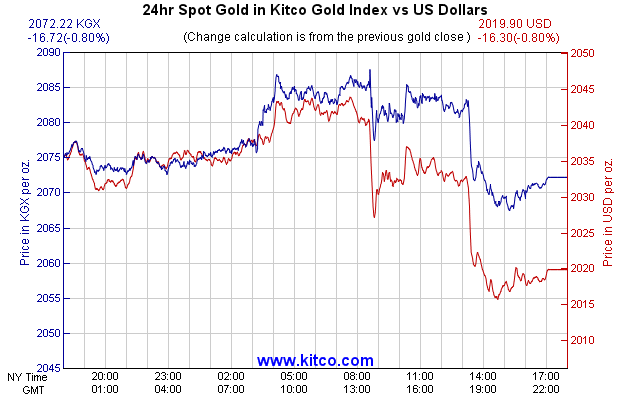
Did gold really go down 21.30?

Precious Metals Date and Time Last (Bid) We assume the closing times of the USD index to be the same as their respective metals. This is part of the reason you will see a variation of the change in the USD Index across different metals. Another reason is because the USD Index calculation happens only when the metal price is updated and only changes with each change in the metal price. That way the indicated strength or weakness in the USD is always correct for the time indicated of the last metal quote. Please mouse over each metal name for more details.Change due to Strengthening of USD Change due to
Normal Trading
Total Change
GoldGold closed at 1767.6 on Aug 11 at 17:15 New York Time. The USD index at that time was 74.536. The last gold quote was at 17:15 on Aug 12 and the USD index at the time was 74.566, indicating a strengthening of the dollar of 0.04% Aug 12, 2011 17:15 1746.30 -0.70-0.04% -20.60-1.17% -21.30-1.21%
SilverSilver closed at 38.64 on Aug 11 at 17:15 New York Time. The USD index at that time was 74.536. The last silver quote was at 17:15 on Aug 12 and the USD index at the time was 74.566, indicating a strengthening of the dollar of 0.04% Aug 12, 2011 17:15 39.07 -0.02-0.04% +0.45+1.15% +0.43+1.11%
PlatinumPlatinum closed at 1787 on Aug 11 at 17:15 New York Time. The USD index at that time was 74.536. The last platinum quote was at 17:03 on Aug 12 and the USD index at the time was 74.566, indicating a strengthening of the dollar of 0.04% Aug 12, 2011 17:03 1792.00 -0.70-0.04% +5.70+0.32% +5.00+0.28%
PalladiumPalladium closed at 741 on Aug 11 at 17:15 New York Time. The USD index at that time was 74.536. The last palladium quote was at 17:03 on Aug 12 and the USD index at the time was 74.566, indicating a strengthening of the dollar of 0.04% Aug 12, 2011 17:03 743.00 -0.30-0.04% +2.30+0.31% +2.00+0.27%
Energy Date and Time Last (Bid) We assume the closing times of the USD index to be the same as their respective metals. This is part of the reason you will see a variation of the change in the USD Index across different metals. Another reason is because the USD Index calculation happens only when the metal price is updated and only changes with each change in the metal price. That way the indicated strength or weakness in the USD is always correct for the time indicated of the last metal quote. Please mouse over each metal name for more details.Change due to Weakening of USD Change due to
Normal Trading
Total Change
Crude OilCrude oil closed at 85.64 on Aug 11 at 17:30 New York Time. The USD index at that time was 74.582. The last crude oil quote was at 15:47 on Aug 14 and the USD index at the time was 74.566, indicating a weakening of the dollar of 0.02% Aug 14, 2011 15:47 85.30 +0.02+0.02% -0.36-0.42% -0.34-0.40%
Base Metals Date and Time Last (Bid) We assume the closing times of the USD index to be the same as their respective metals. This is part of the reason you will see a variation of the change in the USD Index across different metals. Another reason is because the USD Index calculation happens only when the metal price is updated and only changes with each change in the metal price. That way the indicated strength or weakness in the USD is always correct for the time indicated of the last metal quote. Please mouse over each metal name for more details.Change due to Strengthening of USD Change due to
Normal Trading
Total Change
CopperCopper closed at 4.0127 on Aug 12 at 14:00 New York Time. The USD index at that time was 74.615. The last copper quote was at 14:44 on Aug 12 and the USD index at the time was 74.622, indicating a strengthening of the dollar of 0.03% Aug 12, 2011 14:44 3.9809 -0.0012-0.03% -0.0306-0.76% -0.0318-0.79%
NickelNickel closed at 9.6515 on Aug 12 at 14:00 New York Time. The USD index at that time was 74.785. The last nickel quote was at 14:00 on Aug 12 and the USD index at the time was 74.582, indicating a weakening of the dollar of 0.27% Aug 12, 2011 14:00 9.6515 +0.0261+0.27% -0.0261-0.27% 0.00000.00%
AluminumAluminum closed at 1.0679 on Aug 12 at 14:00 New York Time. The USD index at that time was 74.615. The last aluminum quote was at 14:44 on Aug 12 and the USD index at the time was 74.634, indicating a strengthening of the dollar of 0.03% Aug 12, 2011 14:44 1.0656 -0.0003-0.03% -0.0020-0.18% -0.0023-0.21%
ZincZinc closed at 0.9758 on Aug 12 at 14:00 New York Time. The USD index at that time was 74.785. The last zinc quote was at 14:00 on Aug 12 and the USD index at the time was 74.582, indicating a weakening of the dollar of 0.27% Aug 12, 2011 14:00 0.9758 +0.0026+0.27% -0.0026-0.27% 0.00000.00%
LeadLead closed at 1.0743 on Aug 12 at 14:00 New York Time. The USD index at that time was 74.785. The last lead quote was at 14:00 on Aug 12 and the USD index at the time was 74.582, indicating a weakening of the dollar of 0.27% Aug 12, 2011 14:00 1.0743 +0.0029+0.27% -0.0029-0.27% 0.00000.00%
US Dollar Strength, Weakness and the Price of Gold: A Primer

When the US Dollar gets stronger, it takes fewer dollars to buy any commodity that is priced in $USD. When the US Dollar gets weaker it takes more dollars to purchase the same commodity.

The price of all US Dollar denominated commodities, like gold, will change to reflect the fact that it will take fewer or more dollars to buy that commodity. So it’s quite possible, in fact it’s almost always the case that a portion of the change in the price of gold is really just a reflection of a change in the value of the US Dollar. Sometimes that portion is insignificant. But often the opposite is true where the entire change in the gold price is simply a mathematical recalculation of an ever-changing US Dollar value.

When the dollar gets strong, gold appears to go down, and vice versa. That accounts for part of the fluctuations that we see in the value of gold.

The other part is an actual increase in the supply or demand for gold. If the price is higher when being measured not only in US Dollars, but also in Euros, Pounds Sterling, Japanese Yen, and every other major currency, then we know the gold demand is higher and it has actually increased in value.

Consequently, if gold is higher in US Dollars while at the same time cheaper in every other currency, then we can conclude that the US Dollar has weakened, and that gold has actually lost value in all other currencies. But the price, because it is being quoted in $USD will be higher and give the illusion of gold becoming more valuable. In such a case the devaluation of gold, due to increased supply on the market, is camouflaged by a weakened US Dollar.

Our feature on kitco.com breaks the change of the price of gold into 2 components. One part shows you how much of that change can be attributed to US Dollar strength, or lack of it. The other portion is indicative of how much the price changed as a result of normal trading. Interestingly whatever changes happen to the price of gold as a result of US Dollar strength/weakness also occurs to every other US Dollar denominated commodity by the exact same proportion.

About the Kitco Gold Index: What is it and why is it relevant?

The Kitco Gold Index has one purpose, that is to determine whether the value of gold is actual, a reflection of changes in the US Dollar value, or a combination of both.

The U.S. Dollar Index® represents the value of the US Dollar in terms of a basket of six major foreign currencies: Euro (57.6%), Japanese Yen (13.6%), UK Pound (11.9%), Canadian Dollar (9.1%), Swedish Krona (4.2%) and Swiss Franc (3.6%). It is an exchange traded (FINEX) index and has become a standard used worldwide.

The Kitco Gold Index is the price of gold measured not in terms of US Dollars, but rather in terms of the same weighted basket of currencies that determine the US Dollar Index®.

Since the Kitco Gold Index has no US Dollar component it needs to be compared to the actual US Dollar price to give it some perspective. In all of the historical and live charts that we are displaying here we’re showing both trend lines for the purposes of making this comparison. Here are a few possible situations that you may see and what the meaning could be:

The Kitco Gold Index is up and the USD price of gold is up even more:
This would definitely mean that gold has increased in value. It also means that the USD has weakened and so the degree of the gold value increase will be exaggerated when examined strictly in terms of the US Dollar. This is the exact scenario that we’ve witnessed over the span of the early years of the 21st century.

The Kitco Gold Index is down and the USD price of gold is down even more:
This would definitely mean that gold value has declined in value. But not by as much as it may appear in USD terms.

The Kitco Gold Index is up and the USD price of gold is down:
This would indicate that the USD has strengthened relative to the other major currencies, but that gold has gained in value.

The Kitco Gold Index is down and the USD price of gold is up:
This would indicate that the USD has weakened relative to the other major currencies, and that gold is really not up as it may appear.

METALS OUTLOOK: Weaker Trade Possible In Gold If Financial Markets Stabilize

Debbie Carlson METALS OUTLOOK: Weaker Trade Possible In Gold If Financial Markets Stabilize

12 August 2011, 2:43 p.m.
By Debbie Carlson
Of Kitco News
http://www.kitco.com/

(Kitco News) - Gold prices could see some weakness next week if equity and other financial markets stabilize and concerns about the public indebtedness ease somewhat, market watchers said, but losses could be limited.

After reaching an all-time high of $1,817.60 an ounce for the most-active December gold futures on the Comex division of the New York Mercantile Exchange, gold prices fell. Market watchers said the rebound in the equity markets and the CME Group’s decision to raise margins on gold futures helped to cut some of the gains in gold. The CME Group is the parent of the Comex.

The most-active December contract was trading late in the day around $1,742.60. While that is down on the day, it is still up about 5.5% on the week. September silver was trading late in the day around $39.114 an ounce, up on the day, and up about 2.3% on the week.

In the Kitco News Gold Survey, out of 34 participants, 23 responded this week. Of those 23 participants, four see prices up, while 14 see prices down, and four see prices sideways or unchanged. Market participants include bullion dealers, investment banks, futures traders and technical chart analysts

“Gold is currently overheated after a very sharp rally that was very terse in nature, which left it vulnerable to profit-taking,” said Sterling Smith, commodity trading adviser and market analyst with Country Hedging.

For next week, gold’s direction will be dependent “entirely” on how the equities trade, Smith said. The equity markets in Europe received some support from a short-term ban on short-selling by France, Italy, Belgium and Spain. Once that ban is lifted, stock markets could become heavy again because of banking worries there, he said.

He wouldn’t be surprised if gold trades down to the $1,650 area, but said “I would be a very interested buyer there, depending on the condition of the world at that time.”
Jimmy Tintle, analyst at Transworld Futures, noted there is a gap on technical charts around $1,650, which is why some traders believe gold could pull back to that level. He doesn’t think gold prices will fall that far.

Marc Chandler, global head of currency strategy at Brown Brothers Harriman, said market watchers should keep an eye on the meeting next week between France and Germany to help calm markets. “If (German Chancellor Angela) Merkel and (French President Nicolas) Sarkozy fail to propose fresh initiatives next Tuesday; if they merely recommit to the July 21 agreement, they risk adding to the market turmoil. Increasing the size of the EFSF (European Financial Stability Facility), agreeing on a European bond are interesting possibilities, but something bolder would be better. The problem with bolder moves, however, is the weak political base and the treaty and constitutional barriers to fiscal union,” Chandler said.

Tintle also said there are several U.S. economic reports out next week which could give traders a sense of how the economy is faring. “Given the debacle we had this week, next week’s economic reports could give us a sense of just how the economy is doing. If the reports are good, gold prices will go down. But if the reports are bad or mixed, that could support gold prices,” he said.

Given the weakness in gold, some market watchers wonder if gold will see the same break as silver did when the CME Group raised margins. Keep in mind that so far the CME Group has raised margins only once so far in gold, but did so several times in silver. Brian LaRose, technical analyst at United-ICAP, noted several levels of support gold prices need to hold to avoid seeing a sharp break or change in trend. The first support ranges between $1,710 and $1,735, he said. Gold has been in a solid move higher from its lows around $1,478 and for the metal to continue on that rally, it needs to hold support, he said.

Critical support is at $1,550 and if gold prices break through that level, then he said gold prices may have peaked.

That level is distant -- so far – and other technical analysts have said the $1,680 to $1,650s area offers a closer level of near-term support.

In silver, LaRose said critical support is at $34.437 and if that level is broken, it might be a sign silver has peaked for now.

Tintle said regarding silver, if equities can rally, silver will be strong, too. Silver is trading more on its industrial usage qualities and less on its safe-haven allure. He said support for the metal is seen around $37 basis the September futures contract. Below that support comes in at $33.50.

الثلاثاء، 5 يوليو 2011

About gold

Heritage

Despite its unrivalled properties, gold is an inert material. It does nothing until man discovers it, mines and refines it and bends it to his will. So the history of gold is very much the history of civilisation. Here are some points in time where that history was made.

Click on the images to enlarge

  • A smelting furnace

    c. 3600 BC

    First smelting of gold

    Egyptian goldsmiths carry out the first melting or fusing of ores in order to separate the metals inside. They use blowpipes made from fire-resistant clay to heat the smelting furnace.

  • Mesopotamian Headdress

    2600 BC

    Early gold jewellery

    Goldsmiths of ancient Mesopotamia (modern-day Iraq) craft one of the earliest pieces of gold jewellery, a burial headdress of lapis and carnelian beads with willow leaf-shaped gold pendants.

    Image © Trustees of The British Museum

  • Wax models are mounted on a trunk of wax to form a 'wax tree'. The wax is later melted out and molten gold is cast in the cavity.

    1200-1500 BC

    Advances in jewellery making

    Artisans develop the lost-wax jewellery casting technique. The process allows for improved hardness and colour variation which in turn broadens the market for gold products.

  • Tutankhamun's funeral mask

    1223 BC

    Creation of Tutankhamun's funeral mask

    Instantly recognised the world over, the funeral mask of Tutankhamun is a triumph of gold craftsmanship from the ancient world.

  • A reconstruction of Solomon’s temple

    950 BC

    Solomon builds gold temple

    The Queen of Sheba from Yemen presents King Solomon of Israel with 2,500 kilos of gold, bringing the contents of his treasury to 5,700 kilos. Solomon uses part of his holdings to construct his famed temple, allegedly overlaid with gold.

    © Nir Levy

  • First gold dentistry practiced

    600 BC

    First gold dentistry practiced

    The first use of gold in dentistry as the Etruscans begin securing substitute teeth with gold wire. Bio-compatibility, malleability and corrosion resistance still make gold valuable in dental applications.

  • First international gold currency created

    564 BC

    First international gold currency created

    King Croesus develops improved gold refining techniques, permitting him to mint the world's first standardised gold currency. Their uniform gold content allows 'Croesids' to become universally recognised and traded with confidence.

  • The Lycurgus Cup

    300

    First gold nanoparticles

    The Romans use gold to colour the Lycurgus Cup. Melting gold powder into glass diffuses gold nanoparticles throughout which then refract light, giving the glass a luminous red glow.

    Image © Trustees of The British Museum

  • Hallmark in a gold ring

    1300

    Hallmarking practice established

    The world's first hallmarking system, scrutinising and guaranteeing the quality of precious metal, is established at Goldsmith's Hall in London - where London's Assay Office is still located today.

    Image © The Assay office, Birmingham

  • The Great Bullion Famine begins

    1370

    The Great Bullion Famine begins

    During the years 1370-1420, various major mines around Europe become completely exhausted. Mining and production of gold declines sharply throughout the region in a period known as 'The Great Bullion Famine'.

  • Venetian gold ducats

    1422

    Venice's record year

    The Venice Mint strikes a record 1.2 million gold ducats using 4.26 metric tonnes of gold from Africa and Central Asia. These small coins prove popular as they are easy to mint and carry plenty of value.

    Image © Classical Numismatic Group, Inc., CC-BY-SA-2.5, Wikimedia Commons

  • This gold funeral mask dates from pre-Columbian times. Persons of high rank were literally covered in gold after their death.

    1511

    Ferdinand unleashes invasion force

    King Ferdinand of Spain proclaims "Get gold, humanely if you can, but at all hazards, get gold!", launching unprecedented expeditions to the Americas. Within years, the Inca and Aztec civilisations would be virtually destroyed by Spanish conquerors.

  • UK gold standard commences

    1717

    UK gold standard commences

    Britain moves onto a de facto pure gold standard, as the government links the currency to gold at a fixed rate (establishing a mint price of 77 shillings, ten and a half pennies per ounce of gold).

  • First gold electroplating practiced

    1803

    First gold electroplating practiced

    The first recorded experiment in electroplating is carried out by Professor Luigi Brugnatelli at the University of Pavia. Gold electroplating ensures improved conductivity, now essential to many 21st century technologies.

    Image © Deep Blue, CC-BY-SA-3.0, Wikimedia Commons

  • Californian gold rush begins

    1848

    California Gold Rush begins

    John Marshall discovers gold flakes while building a sawmill near Sacramento, California. The greatest gold rush of all time follows as 40,000 diggers flock to California from around the World.

  • Gold ore - Image © Terry Davis

    1885

    South African Gold Rush begins

    While digging up stones to build a house, Australian miner George Harrison finds gold ore on Langlaagte farm near Johannesburg. Miners flock to the region. South Africa will go on to become the source of 40% of the world's gold.

    Image © Terry Davis

  • Replica of a Faberge egg

    1885

    First Faberge Easter egg crafted

    Carl Faberge makes his first gold Imperial Easter Egg for Tsar Alexander III. Named The Hen Egg, it was commissioned as a gift from the Tsar to his wife, the Empress Maria Fedorovna, beginning a tradition that lasts until 1917.

    Image © PetarM, CC-BY-SA-3.0, Wikimedia Commons,

  • Adoption of gold standard

    1870-1900

    Adoption of gold standard

    All major countries other than China switch to the gold standard, linking their currencies to gold. The practice of bimetallism is abandoned.

  • Gold Britannia coins

    1925

    Gold standard returns

    The UK returns to the gold standard at pre-war parity of $4.86=£1 with sterling convertible to gold at 77sh 10.5d per standard ounce. This follows the country's departure from the gold standard six years previously at the outbreak of World War I.

  • Roosevelt suspends gold

    1933

    Roosevelt suspends gold

    President Roosevelt suspends US dollar convertibility to gold (gold at US$20.67/oz). The export of all transactions in, and the holding of gold by private individuals, is forbidden. Presidential proclamation makes the dollar convertible again in January 1934 at a new price of $35 per troy ounce.

  • Supermarine Spitfire Mk 21

    1939

    World War II closes gold market

    The London gold market is closed on the outbreak of war, as at the beginning of World War II. The world will later return to a fixed system of exchange rates, this time with currencies fixed to the dollar and the dollar convertible into gold.

  • John Maynard Keynes (right) represented the UK and Harry Dexter White represented the US at the conference.

    1944

    Bretton Woods conference

    The Bretton Woods conference sets the basis of the post-war monetary system. The US dollar is set to maintain a $35=1 oz gold conversion rate. Other currencies are fixed in terms of US dollar, thus forming a Gold Exchange Standard.

  • Dummy

    1961

    First gold bonded microchips

    Gold bonding wire is used in microchips engineered at Bell Labs in the USA. Nowadays literally billions of chips are bonded this way every year, controlling all manner of indispensible electrical devices.

  • An astronaut on a space walk

    1961

    First gold in space

    The first manned space flight uses gold to protect sensitive instruments from radiation. In 1980, 41kgs of gold is included in space shuttle construction through brazing alloys, fuel cell fabrication and electrical contacts.

  • First South African Krugerrand

    1967

    First South African Krugerrand

    The Krugerrand is introduced in 1967, as a vehicle for private ownership of gold. This iconic coin is actually intended for circulation as currency.

  • Gold window closed

    1971

    Gold window closed

    The Bretton Woods system of fixed exchange rates comes to an end as President Nixon "closes the gold window", suspending US dollar convertibility to gold. The world enters its present day system of floating exchange rates.

  • First gold-based arthritis treatment

    1985

    First gold-based arthritis treatment

    Pharmaceutical giant, SmithKline & French, develops Auranofin, a gold-based drug for the treatment of rheumatoid arthritis. The drug receives regulatory approval and goes on sale for the first time.

  • First Central Bank Gold Agreement

    1999

    First Central Bank Gold Agreement

    The First Central Bank Gold Agreement (CBGA) is agreed. 15 European central banks declare that gold will remain an important element of their reserves and collectively cap gold sales at 400 tonnes per year over next five years.

  • Cardiac stents

    2001

    First gold used in heart surgery

    Boston Scientific markets the first gold-plated stent (Niroyal) used in heart surgery. Inserted inside large arteries and veins, such stents act like scaffolding, propping open the blood vessels to allow adequate flow.

    Image © Richard Lee

  • K-gold jewellery

    2003

    K-gold launched in China

    The World Gold Council creates an entirely new market segment with the launch of K-gold, the first 18k jewellery in China. The jewellery, in predominantly white and yellow gold, takes its inspiration from Italian design.

  • Launch of SPDR<sup>®</sup> Gold Shares

    2004

    Launch of SPDR® Gold Shares

    The market is transformed by an innovative, secure and easy way to access the gold market. Six years later SPDR® exceeds $55bn in assets under management.

  • Central banks return to buying

    2009

    Central banks return to buying

    In the second quarter of the year, central banks collectively become net purchasers of gold for the first time in two decades. This reflects a combination of slowing sales from European banks and growing purchases by emerging market countries.

    Image © Lonely Planet Images

  • Price Chart

    2010

    Gold price sustains record highs

    Fiat currencies are undermined by inflation fears and successive financial crises. The London pm fix achieves 35 separate successive highs in the year to date.

  • Gold in catalytic converters

    2011

    Gold in catalytic converters

    Gold used in catalytic convertors by a leading European diesel car manufacturer. The first use of gold in automotive emissions control.

Atacama Pacific Gold


It is with great pleasure that I welcome you to Atacama Pacific Gold Corporation as the Company enters a new phase in its development. While the Company is relatively new, having just completed an Initial Public Offering on the Toronto Venture Exchange (TSXV:ATM), the management team has an established track record of creating value with public resource companies.


Above: Cerro Maricunga Property, Right: Carl Hansen, President & CEO with Albrecht Schneider, Executive Chairman & Director

Management’s accumulated experience in making major gold discoveries in Chile combined with the Company’s strong balance sheet will allow us the flexibility to aggressively advance our keystone property, the Cerro Maricunga Project in Chile as well as initiate exploration on our portfolio of five additional properties in Chile.

Atacama Pacific’s management team has always been guided by the principle of fiscally responsible exploration through which a project’s potential is measured against various risk factors. This measured approach led to the discovery of the Cerro Maricunga Gold Project, a new discovery in the Maricunga Mineral Belt which stands out from the nearby mines and deposits due it deep level of oxidization. Following up on our successful Phase 1 drilling campaign, the goal of our recently initiated 16,600 metre Phase 2 drilling campaign is to continue to trace to depth the gold mineralization we have identified over a 2,500 metre strike length on surface.

The team at Atacama Pacific is enthusiastic as we move the new company forward. Management is committed to capitalizing its experience to maximize the value of its exploration portfolio to the benefit of our shareholders. I would like to thank all our employees and shareholders for helping us achieve this significant milestone in development of the Company. Your trust is appreciated.

Thank you

Press the "Refresh" button on your browser while holding down the key to refresh this gold