الأحد، 14 أغسطس 2011

Did gold really go down 21.30?

Precious Metals Date and Time Last (Bid) We assume the closing times of the USD index to be the same as their respective metals. This is part of the reason you will see a variation of the change in the USD Index across different metals. Another reason is because the USD Index calculation happens only when the metal price is updated and only changes with each change in the metal price. That way the indicated strength or weakness in the USD is always correct for the time indicated of the last metal quote. Please mouse over each metal name for more details.Change due to Strengthening of USD Change due to
Normal Trading
Total Change
GoldGold closed at 1767.6 on Aug 11 at 17:15 New York Time. The USD index at that time was 74.536. The last gold quote was at 17:15 on Aug 12 and the USD index at the time was 74.566, indicating a strengthening of the dollar of 0.04% Aug 12, 2011 17:15 1746.30 -0.70-0.04% -20.60-1.17% -21.30-1.21%
SilverSilver closed at 38.64 on Aug 11 at 17:15 New York Time. The USD index at that time was 74.536. The last silver quote was at 17:15 on Aug 12 and the USD index at the time was 74.566, indicating a strengthening of the dollar of 0.04% Aug 12, 2011 17:15 39.07 -0.02-0.04% +0.45+1.15% +0.43+1.11%
PlatinumPlatinum closed at 1787 on Aug 11 at 17:15 New York Time. The USD index at that time was 74.536. The last platinum quote was at 17:03 on Aug 12 and the USD index at the time was 74.566, indicating a strengthening of the dollar of 0.04% Aug 12, 2011 17:03 1792.00 -0.70-0.04% +5.70+0.32% +5.00+0.28%
PalladiumPalladium closed at 741 on Aug 11 at 17:15 New York Time. The USD index at that time was 74.536. The last palladium quote was at 17:03 on Aug 12 and the USD index at the time was 74.566, indicating a strengthening of the dollar of 0.04% Aug 12, 2011 17:03 743.00 -0.30-0.04% +2.30+0.31% +2.00+0.27%
Energy Date and Time Last (Bid) We assume the closing times of the USD index to be the same as their respective metals. This is part of the reason you will see a variation of the change in the USD Index across different metals. Another reason is because the USD Index calculation happens only when the metal price is updated and only changes with each change in the metal price. That way the indicated strength or weakness in the USD is always correct for the time indicated of the last metal quote. Please mouse over each metal name for more details.Change due to Weakening of USD Change due to
Normal Trading
Total Change
Crude OilCrude oil closed at 85.64 on Aug 11 at 17:30 New York Time. The USD index at that time was 74.582. The last crude oil quote was at 15:47 on Aug 14 and the USD index at the time was 74.566, indicating a weakening of the dollar of 0.02% Aug 14, 2011 15:47 85.30 +0.02+0.02% -0.36-0.42% -0.34-0.40%
Base Metals Date and Time Last (Bid) We assume the closing times of the USD index to be the same as their respective metals. This is part of the reason you will see a variation of the change in the USD Index across different metals. Another reason is because the USD Index calculation happens only when the metal price is updated and only changes with each change in the metal price. That way the indicated strength or weakness in the USD is always correct for the time indicated of the last metal quote. Please mouse over each metal name for more details.Change due to Strengthening of USD Change due to
Normal Trading
Total Change
CopperCopper closed at 4.0127 on Aug 12 at 14:00 New York Time. The USD index at that time was 74.615. The last copper quote was at 14:44 on Aug 12 and the USD index at the time was 74.622, indicating a strengthening of the dollar of 0.03% Aug 12, 2011 14:44 3.9809 -0.0012-0.03% -0.0306-0.76% -0.0318-0.79%
NickelNickel closed at 9.6515 on Aug 12 at 14:00 New York Time. The USD index at that time was 74.785. The last nickel quote was at 14:00 on Aug 12 and the USD index at the time was 74.582, indicating a weakening of the dollar of 0.27% Aug 12, 2011 14:00 9.6515 +0.0261+0.27% -0.0261-0.27% 0.00000.00%
AluminumAluminum closed at 1.0679 on Aug 12 at 14:00 New York Time. The USD index at that time was 74.615. The last aluminum quote was at 14:44 on Aug 12 and the USD index at the time was 74.634, indicating a strengthening of the dollar of 0.03% Aug 12, 2011 14:44 1.0656 -0.0003-0.03% -0.0020-0.18% -0.0023-0.21%
ZincZinc closed at 0.9758 on Aug 12 at 14:00 New York Time. The USD index at that time was 74.785. The last zinc quote was at 14:00 on Aug 12 and the USD index at the time was 74.582, indicating a weakening of the dollar of 0.27% Aug 12, 2011 14:00 0.9758 +0.0026+0.27% -0.0026-0.27% 0.00000.00%
LeadLead closed at 1.0743 on Aug 12 at 14:00 New York Time. The USD index at that time was 74.785. The last lead quote was at 14:00 on Aug 12 and the USD index at the time was 74.582, indicating a weakening of the dollar of 0.27% Aug 12, 2011 14:00 1.0743 +0.0029+0.27% -0.0029-0.27% 0.00000.00%
US Dollar Strength, Weakness and the Price of Gold: A Primer

When the US Dollar gets stronger, it takes fewer dollars to buy any commodity that is priced in $USD. When the US Dollar gets weaker it takes more dollars to purchase the same commodity.

The price of all US Dollar denominated commodities, like gold, will change to reflect the fact that it will take fewer or more dollars to buy that commodity. So it’s quite possible, in fact it’s almost always the case that a portion of the change in the price of gold is really just a reflection of a change in the value of the US Dollar. Sometimes that portion is insignificant. But often the opposite is true where the entire change in the gold price is simply a mathematical recalculation of an ever-changing US Dollar value.

When the dollar gets strong, gold appears to go down, and vice versa. That accounts for part of the fluctuations that we see in the value of gold.

The other part is an actual increase in the supply or demand for gold. If the price is higher when being measured not only in US Dollars, but also in Euros, Pounds Sterling, Japanese Yen, and every other major currency, then we know the gold demand is higher and it has actually increased in value.

Consequently, if gold is higher in US Dollars while at the same time cheaper in every other currency, then we can conclude that the US Dollar has weakened, and that gold has actually lost value in all other currencies. But the price, because it is being quoted in $USD will be higher and give the illusion of gold becoming more valuable. In such a case the devaluation of gold, due to increased supply on the market, is camouflaged by a weakened US Dollar.

Our feature on kitco.com breaks the change of the price of gold into 2 components. One part shows you how much of that change can be attributed to US Dollar strength, or lack of it. The other portion is indicative of how much the price changed as a result of normal trading. Interestingly whatever changes happen to the price of gold as a result of US Dollar strength/weakness also occurs to every other US Dollar denominated commodity by the exact same proportion.

About the Kitco Gold Index: What is it and why is it relevant?

The Kitco Gold Index has one purpose, that is to determine whether the value of gold is actual, a reflection of changes in the US Dollar value, or a combination of both.

The U.S. Dollar Index® represents the value of the US Dollar in terms of a basket of six major foreign currencies: Euro (57.6%), Japanese Yen (13.6%), UK Pound (11.9%), Canadian Dollar (9.1%), Swedish Krona (4.2%) and Swiss Franc (3.6%). It is an exchange traded (FINEX) index and has become a standard used worldwide.

The Kitco Gold Index is the price of gold measured not in terms of US Dollars, but rather in terms of the same weighted basket of currencies that determine the US Dollar Index®.

Since the Kitco Gold Index has no US Dollar component it needs to be compared to the actual US Dollar price to give it some perspective. In all of the historical and live charts that we are displaying here we’re showing both trend lines for the purposes of making this comparison. Here are a few possible situations that you may see and what the meaning could be:
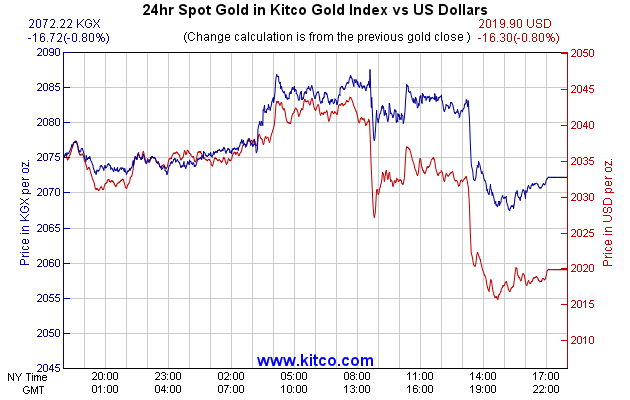
The Kitco Gold Index is up and the USD price of gold is up even more:
This would definitely mean that gold has increased in value. It also means that the USD has weakened and so the degree of the gold value increase will be exaggerated when examined strictly in terms of the US Dollar. This is the exact scenario that we’ve witnessed over the span of the early years of the 21st century.

The Kitco Gold Index is down and the USD price of gold is down even more:
This would definitely mean that gold value has declined in value. But not by as much as it may appear in USD terms.

The Kitco Gold Index is up and the USD price of gold is down:
This would indicate that the USD has strengthened relative to the other major currencies, but that gold has gained in value.

The Kitco Gold Index is down and the USD price of gold is up:
This would indicate that the USD has weakened relative to the other major currencies, and that gold is really not up as it may appear.

METALS OUTLOOK: Weaker Trade Possible In Gold If Financial Markets Stabilize

Debbie Carlson METALS OUTLOOK: Weaker Trade Possible In Gold If Financial Markets Stabilize

12 August 2011, 2:43 p.m.
By Debbie Carlson
Of Kitco News
http://www.kitco.com/

(Kitco News) - Gold prices could see some weakness next week if equity and other financial markets stabilize and concerns about the public indebtedness ease somewhat, market watchers said, but losses could be limited.

After reaching an all-time high of $1,817.60 an ounce for the most-active December gold futures on the Comex division of the New York Mercantile Exchange, gold prices fell. Market watchers said the rebound in the equity markets and the CME Group’s decision to raise margins on gold futures helped to cut some of the gains in gold. The CME Group is the parent of the Comex.

The most-active December contract was trading late in the day around $1,742.60. While that is down on the day, it is still up about 5.5% on the week. September silver was trading late in the day around $39.114 an ounce, up on the day, and up about 2.3% on the week.

In the Kitco News Gold Survey, out of 34 participants, 23 responded this week. Of those 23 participants, four see prices up, while 14 see prices down, and four see prices sideways or unchanged. Market participants include bullion dealers, investment banks, futures traders and technical chart analysts

“Gold is currently overheated after a very sharp rally that was very terse in nature, which left it vulnerable to profit-taking,” said Sterling Smith, commodity trading adviser and market analyst with Country Hedging.

For next week, gold’s direction will be dependent “entirely” on how the equities trade, Smith said. The equity markets in Europe received some support from a short-term ban on short-selling by France, Italy, Belgium and Spain. Once that ban is lifted, stock markets could become heavy again because of banking worries there, he said.

He wouldn’t be surprised if gold trades down to the $1,650 area, but said “I would be a very interested buyer there, depending on the condition of the world at that time.”
Jimmy Tintle, analyst at Transworld Futures, noted there is a gap on technical charts around $1,650, which is why some traders believe gold could pull back to that level. He doesn’t think gold prices will fall that far.

Marc Chandler, global head of currency strategy at Brown Brothers Harriman, said market watchers should keep an eye on the meeting next week between France and Germany to help calm markets. “If (German Chancellor Angela) Merkel and (French President Nicolas) Sarkozy fail to propose fresh initiatives next Tuesday; if they merely recommit to the July 21 agreement, they risk adding to the market turmoil. Increasing the size of the EFSF (European Financial Stability Facility), agreeing on a European bond are interesting possibilities, but something bolder would be better. The problem with bolder moves, however, is the weak political base and the treaty and constitutional barriers to fiscal union,” Chandler said.

Tintle also said there are several U.S. economic reports out next week which could give traders a sense of how the economy is faring. “Given the debacle we had this week, next week’s economic reports could give us a sense of just how the economy is doing. If the reports are good, gold prices will go down. But if the reports are bad or mixed, that could support gold prices,” he said.

Given the weakness in gold, some market watchers wonder if gold will see the same break as silver did when the CME Group raised margins. Keep in mind that so far the CME Group has raised margins only once so far in gold, but did so several times in silver. Brian LaRose, technical analyst at United-ICAP, noted several levels of support gold prices need to hold to avoid seeing a sharp break or change in trend. The first support ranges between $1,710 and $1,735, he said. Gold has been in a solid move higher from its lows around $1,478 and for the metal to continue on that rally, it needs to hold support, he said.

Critical support is at $1,550 and if gold prices break through that level, then he said gold prices may have peaked.

That level is distant -- so far – and other technical analysts have said the $1,680 to $1,650s area offers a closer level of near-term support.

In silver, LaRose said critical support is at $34.437 and if that level is broken, it might be a sign silver has peaked for now.

Tintle said regarding silver, if equities can rally, silver will be strong, too. Silver is trading more on its industrial usage qualities and less on its safe-haven allure. He said support for the metal is seen around $37 basis the September futures contract. Below that support comes in at $33.50.